
Foreign Entity of Concern (FEOC) Rules for Commercial Solar Projects
- Published
- Updated 04/29/2026
The Foreign Entities of Concern (FEOC) solar rules determine whether a project qualifies for the federal solar tax credit. These time-limited eligibility standards have become the central consideration for business planning of commercial solar projects. StraightUp Solar will help your business navigate the tax credit regulations and incentives with confidence. With early planning and close coordination between your team and a full-service solar company like StraightUp Solar, FEOC requirements are manageable. We’ve found that compliance is most effective when it’s integrated into project design, equipment sourcing, and construction from the very beginning.
For commercial solar projects, FEOC risk is a procurement and contracting issue, not a post-construction problem. FEOC regulations require up-front diligence and contractual protections to preserve tax credit eligibility. Most risk exposure comes from upstream supply chain opacity, not intentional non-compliance. These are known, manageable issues when addressed early.
JULY 4, 2026 SAFE HARBOR CUTOFF APPROACHING: Meet the July 4, 2026 Safe Harbor milestone to lock in your 30% federal tax credit and a flexible four-year construction window. This protects your ROI from utility delays and ensures maximum equipment choice before stricter 2027 rules take effect. Find out how to secure your project flexibility today.
What is a Foreign Entity of Concern in Solar?
The FEOC rules restrict federal solar incentives when commercial solar projects use certain foreign-sourced components or products owned by prohibited foreign-owned or controlled companies. A Foreign Entity of Concern is an entity classified as either a “specified foreign entity” (SFE) or a “foreign-influenced entity” (FIE) that may be categorized as a prohibited foreign entity (PFE) for the purposes of qualifying federal clean energy tax credits.
To be eligible for tax credits in 2026 and 2027, the suppliers of your project components must be FEOC-compliant, meaning an entity certified to be free of SFE or FIE control. Foreign Entities of Concern are companies owned, headquartered, or performing relevant activities (such as production and manufacturing) in China, Russia, North Korea, and Iran. The FEOC definition applies to the project company, EPC company, O&M providers, and key manufacturers. Where the equipment is assembled does not affect the company’s FEOC definition. For instance, if a component is assembled in the United States but the company is owned or its management decisions are controlled by citizens of a FEOC country, then that component may not be eligible for the tax credit.
The project must meet a threshold of the percentage of component costs from non-”specified foreign entities (SPE)” to be eligible for the commercial solar tax credit and its adders. These thresholds determine FEOC solar tax credit eligibility, not overall project viability.
The threshold for solar projects is 40% in 2026 and 45% in 2027. For battery storage projects the threshold is 55% for 2026 and 60% for 2027.
Providing Expert Guidance on FEOC and Domestic Content

StraightUp Solar will evaluate the modules, racking, battery storage, and inverters for FEOC compliance based on our manufacturers and supply partners, their FEOC-compliant status, and the domestic content statement documents. We vet equipment selections before contracts are finalized, because document compliance is a standard project deliverable, not an afterthought.
Additionally, StraightUp Solar is a member of the Amicus Solar Cooperative, a buying group of more than 80 solar companies from across the country. Through the Amicus Solar Cooperative and our own supply chain, we can source cost-effective equipment to satisfy the domestic content and FEOC requirements to put you in the best situation to claim the tax credit. This expanded access helps reduce supply chain risk for foreign entity of concern solar compliance while maintaining project economics.
Act Early to Secure Solar Tax Credits
Understanding FEOC early and following a safe harbor strategy helps project teams preserve solar tax credit eligibility that can represent 30-50% of the total project cost. In many cases, the actual cost of the solar installation will be less than a quarter of the initial costs after eligible solar incentives are applied. Waiting until mid-year or later limits equipment and supplier options to comply with FEOC regulations. Projects contracted earlier have more flexibility and better compliance outcomes.

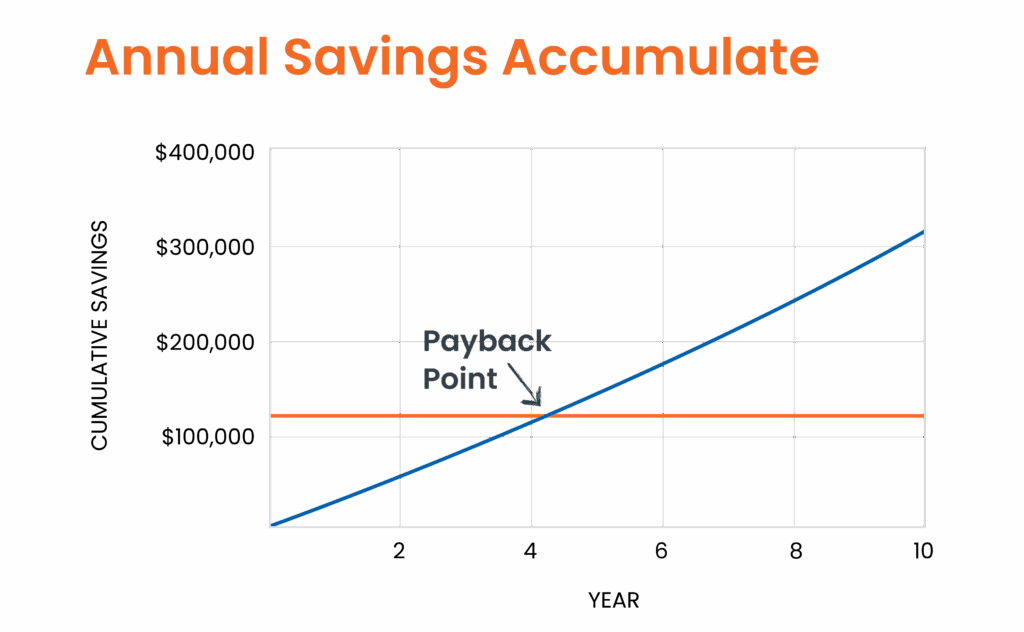
Disclaimer: Charts are for example purposes only. Your incentives may differ depending on eligibility. Please consult with your tax advisor to see how the Federal Tax Credit can work best for you.
Start Your Commercial Project with FEOC Compliance Built In
StraightUp Solar’s team of experienced project developers and estimators can get you started today. We design and build the project with FEOC compliance integrated, not bolted on as an afterthought. Our solar professionals stay engaged with your team over the life of the asset, including providing ongoing operations and maintenance post-construction, if desired.
LOCAL BUSINESSES
Trust StraightUp Solar